ERP
A Practical School Financial Reforecasting Method for Changes in Enrolment
A step-by-step change-trigger process for updating the forecast when enrolment, staffing or fees shift, with owners, key assumptions and a monthly review routine.
November 6, 2026
Quick Answer
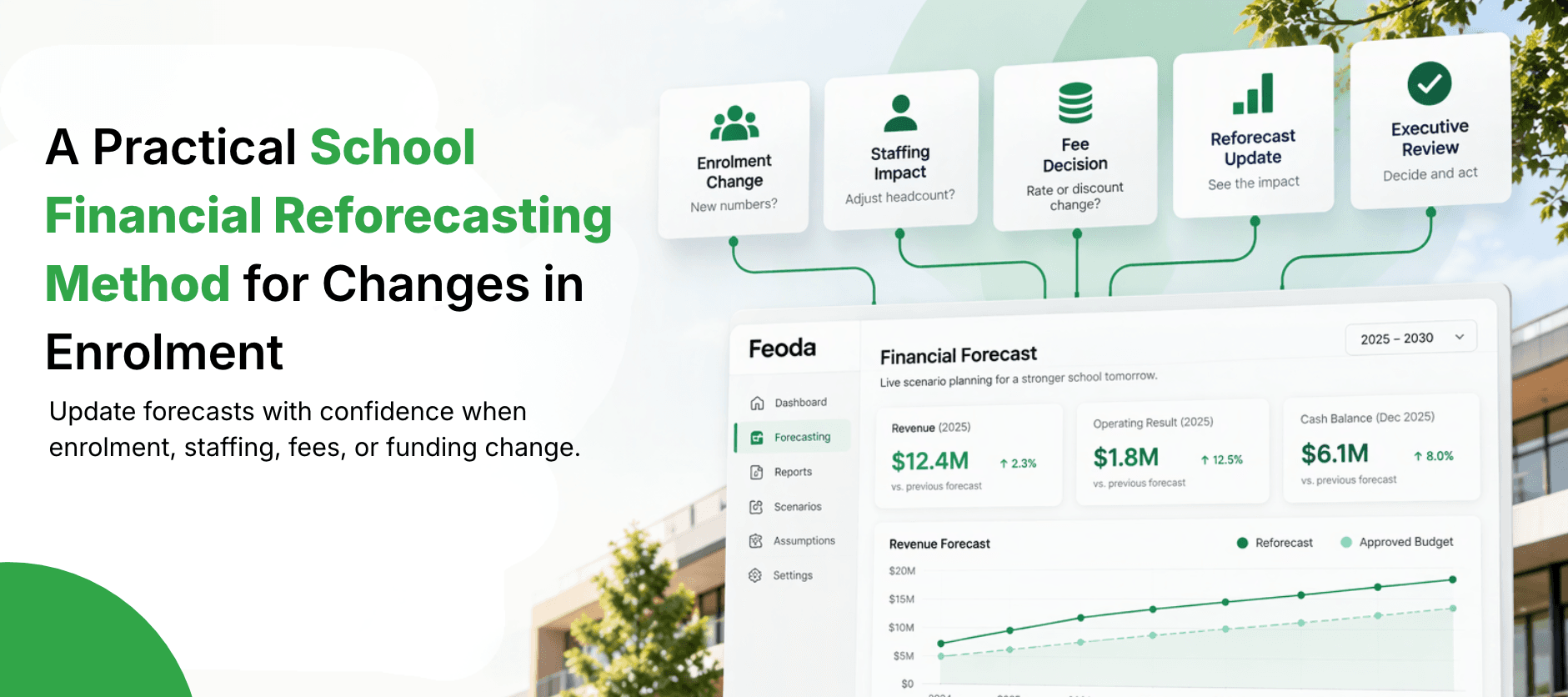
A school should update its financial forecast when something changes enough to matter, such as enrolment moving away from the forecast, a wage outcome, a fee or discount decision, a large variance in actuals, or a change in capital or grant timing. A simple method is to log the change, confirm it with its owner, update the assumption once, see the effect on revenue, staffing and the result, compare it with the approved budget and the previous forecast, then record and share it. Checking the trigger list every month keeps school financial forecasting light and timely.
Key Takeaways
- Reforecast when a defined trigger is hit, not only on a fixed date.
- Every trigger should have an owner and a named assumption it changes, so updates are quick and traceable.
- The reforecast sits beside the approved budget. It never replaces it.
It's the second week of the month, and admissions mentions that twelve fewer students have confirmed than the forecast assumed. Nobody is alarmed, and nobody is sure whether the forecast should change. By the time the question reaches the finance team, three weeks have passed and a fee decision has been made on the older number.
The issue isn't the size of the change. It's that there was no agreed way to turn a change into a forecast update. A simple trigger process closes that gap, and it works whether the school forecasts in a workbook or in a planning platform.
When Should a School Update Its Financial Forecast?
A school should update its forecast when a defined trigger is reached. Setting the triggers in advance, with an owner for each, turns a vague feeling that something has changed into a clear next step:
| Trigger | Typical Owner | Assumption It Affects | First Action |
|---|---|---|---|
| Enrolment moves from the forecast by more than the agreed threshold | Admissions or registrar | Enrolment by year level | Update the enrolment assumption and review revenue and staffing. |
| Wage outcome or staffing change | HR or Principal | Salary increase and headcount | Update the staffing assumption and the full-year cost. |
| Fee change or discount decision | Business manager | Fee rates and discount percentages | Update the fee assumption and net billed fees. |
| Large variance in actuals | Finance team | The line concerned | Find the cause and decide whether it is timing or ongoing. |
| Capital project timing changes | Operations or business manager | Capital spend and cash | Update the timing and the cash profile. |
| Grant or funding change | Business manager | Grant income | Update the amount and timing. |
What Is the Difference Between a Reforecast and the Original Budget?
| Question | Approved Budget | Reforecast |
|---|---|---|
| What is it for? | The plan and spending authority for the year. | The latest view of where the year is heading. |
| Does it change during the year? | No, it stays as approved. | Yes, whenever a trigger is reached. |
| What is it based on? | Assumptions at one point in time. | Actuals so far plus updated assumptions. |
| Who uses it? | The Board, as the baseline for accountability. | Finance and the Executive, with a summary for the Board. |
What Is a Step-by-Step Reforecast Workflow?
- Log the change: record what changed, when and who reported it.
- Confirm it with its owner: check the source so the update rests on fact, not rumour.
- Update the assumption once: in the single place where that assumption lives.
- See the effect: on revenue, staffing, costs and the operating result.
- Compare: with the approved budget and with the previous forecast.
- Decide what to do: whether the school needs to act, or simply to note the change.
- Record and share: with a short note for the Executive, and the Board where the change is material.
What Does a Change in Enrolment Look Like in a Reforecast?
Here is a simple illustration with example numbers. Twelve fewer students at an average net fee of 15,000 reduces fee income by 180,000. Whether that falls to the result depends on staffing. If no class can be merged, staffing costs stay the same and the full 180,000 reduces the result. If one class can be consolidated and the saving is 100,000, the net effect is 80,000.
That difference is the reason enrolment changes should be traced through staffing, and not only through revenue. A reforecast that only updates fee income will overstate the damage, and one that assumes costs fall automatically will understate it.
What Does a Monthly Review Routine Look Like?
The routine doesn't need to be long. A short review after each month end is enough:
- Close and reconcile actuals: so the review starts from reliable numbers.
- Check enrolment movements: against the forecast, by year level.
- Review the trigger list: and note which triggers have been reached.
- Update the assumptions that moved: once each, and refresh the forecast.
- Compare scenarios: an expected case and a cautious case side by side.
- Write a short commentary: what changed, why, and what it means for the year.
- Share with the Executive: and with the Board when the change is material.
Why Does Reforecasting Often Feel Heavy?
Because in a workbook-based process each step can mean updating more than one file. An enrolment change has to be carried to revenue, staffing and the Board paper, and each copy is a chance for the files to drift apart. The effort comes from keeping them in step, not from the thinking.
None of this reflects a lack of skill. It reflects a structure where assumptions and forecasts live in different places.
Now Imagine the Version That Works
Imagine logging a change, updating one assumption, and watching revenue, staffing and the operating result update together. The expected and cautious scenarios sit side by side, the approved budget stays visible, and the commentary starts from a draft that already exists.
That's what PULSE, Feoda's planning, budgeting, forecasting and reporting platform built for schools, is designed to support. It links assumptions, updates forecasts and compares scenarios, working alongside the school's finance system. Existing workbooks can be the starting point, and the finance team keeps control of the assumptions.
Frequently Asked Questions
When a defined trigger is reached, such as enrolment moving away from the forecast, a wage outcome, a fee or discount decision, a large variance in actuals, or a change in capital or grant timing. Many schools also review the trigger list monthly.
Related Articles
- ERPHow to Calculate the Time and Cost of Manual School Fee Reconciliation
- ERPHow to Improve School Enrolment Forecasting: 5 Inputs Finance Teams Should Track
- ERPWhy Does the Mid-Year Reforecast Feel Like Starting the Budget Over Again?
- ERPWhat Does a School Board Actually Ask Before Approving Next Year's Budget?
- ERPHow Long Does It Typically Take to Implement Oracle NetSuite for a School or University?
- ERPWhat Is a Finance System, and Does a School or University Actually Need One?
- School BudgetingHow Do Schools Forecast Tuition Revenue? A Practical Guide for Finance Teams
- School BudgetingHow Do Schools Forecast Enrolment and Turn Student Numbers Into a Revenue Plan?